Projectors are More Popular than Ever Now – Here’s Why
4th February, 2026
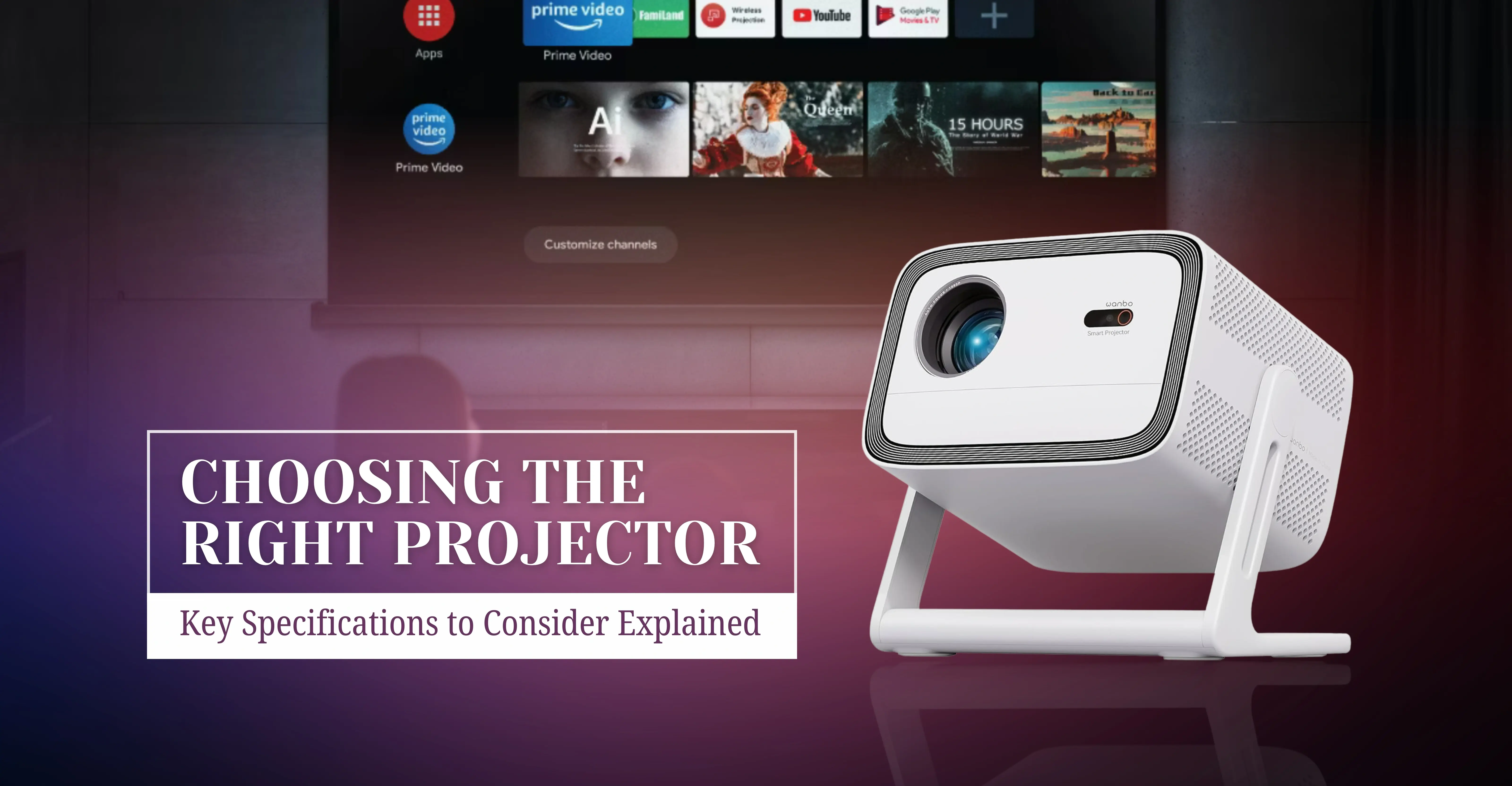
Nowadays, projectors are no longer limited to classrooms or office meetings. They’re becoming a common choice for home theaters, gaming setups, screening in mass events, and even small businesses. A projector is a display device that projects images or videos on a flat surface, commonly a projection screen. Projectors can create a much larger viewing experience compared to traditional displays or TVs.
Projectors were used mostly for their portability and ease of use, and with recent improvement in technology, they’ve become more affordable, compact and powerful than ever. From home theaters and presentations to education and entertainment, projectors are used everywhere now.
Key Specifications to Consider
Demand for projectors has been rapidly growing in recent years and varieties of projectors are now available in the market to choose from. Choosing the right projector for you heavily depends on its specification. Some most important ones are explained below:
Brightness & Contrast
Projector brightness, generally measured in Lumens, is the total light output of the projector that determines how bright and visible the projected image will be. The right brightness depends entirely on where you’ll use the projector:
- a. Dark Room / Home Theater: 1000-2500 Lumens
- b. Living Rooms with some ambient light: 2500-3500 Lumens
- c. Classrooms / Large Venues / Outdoor Events: 3500-5000+ Lumens
Similarly, the contrast ratio of a projector refers to the ratio of the luminance of the brightest white to the darkest black that the projector can produce. It is written as a ratio like 10,000:1 or 3,00,000:1. A higher contrast ratio means images have more vibrant colors, improved readability and depth whereas a lower contrast ratio can lead to flat, washed-out looks.
Throw Ratio
A projector’s throw ratio is the ratio between the Distance (D) of the projector’s lens from the screen to the width of the image (W) that it will project. It determines where the projector should be placed in your room. Short throw projectors have ratios from 0.4:1 to 1.0:1 and can be placed very close to the screen; best for small rooms. Standard and long throw projectors have ratios of 1.0:1 to 2.0:1 and higher; suitable for big rooms or auditoriums. Nowadays, most projectors have a zoom range for giving you flexibility on projector placement.
Imaging Technology
Different projectors in the market use different technologies to project the image onto the screen. There are mainly three imaging technologies DLP, LCD and LED.
- a. DLP (Digital Light Processing) technology uses a microchip with millions of tiny mirrors, each mirror tilted to reflect light and create pixels. This produces a very sharp image, higher contrast and fast response. Although these projectors may sometimes show “Rainbow Effect” in high contrast scenes. These are best for Home theaters and Gaming purposes.
- b. LCD (Liquid Crystal Display) or 3LCD technology uses three separate LCD panels (red, green, blue) and a prism to bend colors directly. This delivers vibrant colors and is more energy-efficient. But these have lower native contrast than DLP and may suffer from color fading over years of use. These are best for Bright rooms, classrooms and presentations.
- c. LED (Light Emitting Diode) usually uses DLP imaging technology with tiny LED projectors. LED projectors usually produce very pure colors, have extremely long life and are more energy efficient. But these types of projectors have very limited brightness and are not recommended for rooms with lots of ambient lighting.
Resolution
One of the major aspects of a projector is its resolution. Resolution is the number of pixels that make up the image projected on the screen. Most commonly preferred resolutions for projects are HD, Full HD, 4K UHD, 8K and some special business resolutions such as WXGA and XGA. Generally, Full HD (1080p) or low-res XGA resolution can be sufficient for schools, colleges and presentations. But for watching movies or playing games, 4k or higher resolutions are recommended for better experience.
Connectivity
Even with high end resolution, brightness and contrast, a projector’s usage is mainly determined by its connectivity options i.e. types and no of input/output ports and wireless connectivity.
Enough HDMI ports are necessary for traditional connections. Projectors also come with different USB ports and audio ports for versatility. Modern projectors also come with wireless connection options to cast screens of your laptop or smartphone directly.
Utilities
Nowadays, modern projectors also come with multiple utilities and quality of life features. Projectors come with Standard IR remotes, backlit remotes or even with App control to remotely control and configure the projector. Some projectors also have Auto Power On and Schedule Timer features. There are also some interactive projectors with touch and pen control, annotation, split screen and cloud upload features.
How are Projectors better than TVs?
Let’s be honest, at some point most of us had thought: “if only this TV was a little bigger…or maybe a little smaller”. One day the TV feels too small for movies, the next day it feels too big for the room. And apparently the solution is to buy another TV. That’s where projectors come to save you from such restraints.
For the price of a decent 75-inch TV, you can get a much better 120-inch cinematic experience with a projector which is also adjustable. A projector basically disappears on the ceiling and can be easily moved from one room to another. Unlike Digital Boards like BenQ Smartboards which emit direct light, projectors bounce light off a screen which puts much less strain on your eyes. Most projectors can show multiple resolution contents effectively. Projectors are also much more flexible on use cases and future upgrades. Projectors are now creating a significant niche where they are superior and are growing to become a mainstream alternative for TVs in most use cases.
Which Projector Should You Choose?
Choosing the right projector is about matching the projector to how and where you’ll actually use it. Below are some recommended projectors based on different general use cases so you can select the one that fits you best.
- a. For Home Movies and Streaming, the WANBO Vali 1 projector offers good brightness, contrast and 4K support.
- b. For Office and Business use BenQ MX560 projector is a reliable choice as it has 4000 lumens of brightness and XGA resolution for clear text and graphs as well as built-in 10W speaker, HDMI support and long lamp life.
- c. For Schools and Classrooms, the Infocus IN114AA DLP projector is an easy to operate, budget-friendly and dependable option.
- d. The Wanbo Mini Pro 720p HD smart projector is good for those who want a flexible and portable option perfect for travelling, small rooms and casual outdoor movie nights.
- e. For all the Gamers out there, Yaber L2 Plus Smart Full HD Projector provides a great balance of responsiveness, clarity and smart connectivity features.
Ultimately, the best projector is the one that fits your needs the best. So talking a little time to choose the right model can make all the difference.
Conclusion
Well, by now you should have properly understood how projectors have evolved and how choosing the right projector can completely transform your viewing experience. Instead of just choosing the most expensive option, choose the one that fits your space and needs the most. If you’re still confused, you can visit our store and we will surely guide you to choose the perfect projector for you.
Related Blogs
MacBook Air M5: Apple’s Most Popular Macbook Gets a Big Upgrade
13th March, 2026
iPhone 17e: Apple’s Most Affordable A19-Powered iPhone Yet
11th March, 2026
Everything you need to know about Samsung S26 Series
10th March, 2026
MacBook Neo: The Perfect Balance Between Power and Price
9th March, 2026
Detailed Guide On Earbuds, Explore, Choose and Buy
26th February, 2026
From Budget to Flagship: Best Smartphones to Buy in Nepal
10th February, 2026
Dahua LM27 U401A Review
6th February, 2026
Ready to Build Your First PC? Here’s Everything You Need to Know
5th February, 2026
iPhone 18 - Expected Launch Date in Nepal & full Specs
2nd February, 2026