NVIDIA RTX Spark Full Specifications
15th June, 2026
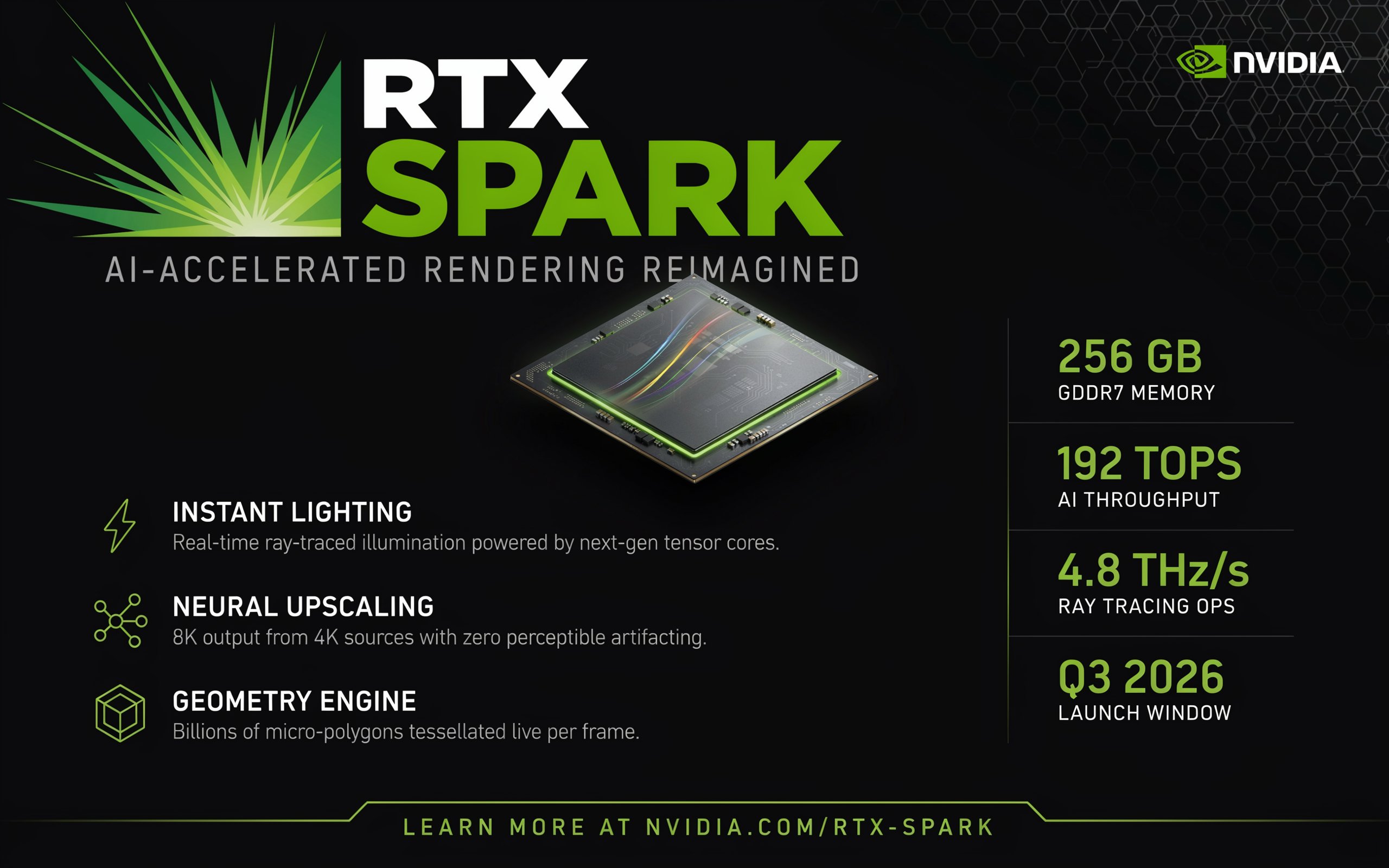
RTX Spark is NVIDIA’s attempt to turn a PC into a single, unified AI computing system instead of the traditional mix of separate CPU and GPU parts. It’s built around a new ARM-based processor combined with a powerful Blackwell-class GPU and shared high-capacity memory, designed specifically to run demanding AI workloads locally. In simple terms, it’s not just a faster laptop chip but it’s a new kind of computer architecture meant to handle large AI models, creative tools, and advanced computing tasks directly on your device without relying heavily on the cloud.
You should care because it signals where personal computing is heading: away from “apps you control” and toward “AI systems that work for you.” That changes everything from how software is built to how creative, coding, and productivity tasks are done. The timing matters because AI models are getting too large and too expensive to run efficiently in the cloud alone, pushing companies to bring that power on-device. And “why you” matters because if this direction sticks, future laptops and desktops won’t just be faster they’ll behave like always-on AI assistants built into the hardware itself, reshaping everyday workflows whether you're a creator, student, or developer.
NVIDIA RTX Spark Specifications
How NVIDIA's RTX Spark Works?
NVIDIA RTX Spark works by combining multiple computing components into one tightly integrated system so AI tasks can run directly on the device instead of being split across separate hardware or sent to the cloud.
At its core is a single system-on-chip (SoC) built by NVIDIA that includes an ARM-based CPU, a Blackwell-class GPU, and dedicated AI acceleration hardware. All of these share a unified memory pool, meaning data doesn’t need to constantly move between separate CPU and GPU memory like in traditional PCs. That reduces delay and makes it much faster to process large AI models, graphics, and simulations in real time. When you run an AI tasks like generating text, images, or using an AI assistant, the CPU handles instructions and system logic. Also the GPU performs massive parallel computation for AI model inference. The integrated AI engines accelerate specific operations like matrix math (which is what neural networks rely on). Because everything is on one chip with shared memory, the system can keep large AI models loaded and “active,” allowing it to respond instantly and even run multiple AI processes at once.
In short, RTX Spark works like a mini AI data center inside your device, where CPU + GPU + AI hardware all collaborate through shared memory to run intelligent workloads locally, efficiently, and continuously.
NVIDIA RTX Spark: The Beginning of the AI-Native PC Era
The personal computer industry is entering one of its most dramatic shifts in decades, and NVIDIA is positioning itself at the center of it. With the introduction of RTX Spark, the company is no longer just a leader in GPUs, it is attempting to redefine what a PC actually is. Instead of the traditional separation between CPU, GPU, and AI accelerators, RTX Spark merges everything into a single, tightly integrated system built for a new kind of computing: AI-native, agent-driven workloads.
A New Class of Computing Platform
RTX Spark is not a conventional processor upgrade. It is a system-on-chip (SoC) designed for laptops and compact desktops that blends a 20-core ARM-based CPU, a powerful Blackwell architecture GPU, and a large pool of unified memory. In total, the platform delivers up to 128GB of shared LPDDR5X memory, enabling workloads that were previously limited to servers or cloud data centers.
This design reflects NVIDIA’s broader strategy: shift computing away from siloed components and toward a unified architecture optimized for AI execution. Instead of relying on cloud services, RTX Spark is designed to run large AI models directly on the device, enabling local intelligence without constant internet dependency.
Built for AI Agents, Not Just Applications
What makes RTX Spark fundamentally different from previous PC chips is its focus on AI agents—software systems that can independently reason, plan, and execute tasks. According to NVIDIA’s positioning, the chip is capable of handling extremely large AI workloads locally, including:
- Running large language models with extremely long context windows
- Generating and editing high-resolution video content
- Rendering complex 3D environments in real time
- Powering autonomous AI “agents” that can perform multi-step tasks
This marks a shift from traditional computing, where users manually control applications, toward systems where software can act on behalf of the user continuously and intelligently.
GPU Power Meets ARM Efficiency
At its core, RTX Spark integrates a Blackwell-based GPU with thousands of CUDA cores, reportedly matching performance levels close to high-end laptop Graphics Cards such as the RTX 5070-class segment. Alongside this sits a 20-core ARM CPU built using a combination of high-performance and efficiency-focused designs.
However, unlike desktop GPUs that rely on high-power GDDR memory, RTX Spark uses unified LPDDR5X memory. This creates a trade-off: while memory is more efficient and tightly integrated, bandwidth is lower than traditional discrete GPU setups. Even so, NVIDIA claims the platform can deliver around one petaflop of AI performance, positioning it as a bridge between consumer laptops and AI workstations.
Windows PCs Reimagined with Microsoft
One of the most significant aspects of RTX Spark is its deep integration with Microsoft’s Windows ecosystem. The partnership aims to turn Windows into an “agentic operating system”, where AI assistants are embedded directly into the desktop experience. Instead of treating AI as an add-on feature, RTX Spark systems are designed so that:
- AI tools are always available at the OS level
- Developers can build persistent, local AI agents
- Security frameworks are redesigned for autonomous software behavior
This collaboration suggests that future Windows PCs may behave less like traditional machines and more like interactive AI environments.
Where RTX Spark Will Be Used
RTX Spark is expected to power a new generation of premium devices, including:
- High-end laptops from manufacturers like ASUS, Dell, HP, Lenovo, MSI, and Microsoft
- Compact desktop workstations designed for developers and creators
- AI-focused “personal supercomputers” for local model training and inference
These systems are not aimed at mainstream consumers initially. Instead, they target developers, AI researchers, content creators, and professionals who require heavy compute power at the edge.
Performance Positioning and Trade-Offs
Early benchmarks and architectural analysis suggest RTX Spark sits between Apple’s high-end silicon and traditional x86 laptop platforms. It may outperform some workloads on competing systems while falling behind in others, particularly where CPU-only performance or memory bandwidth dominates.
Its strengths appear in:
- GPU-accelerated workloads
- AI inference and model execution
- Parallel compute tasks
- Creative workflows optimized for CUDA and RTX tools
However, constraints include:
- Lower memory bandwidth compared to discrete GPU systems
- Power limits in thin laptops and compact desktops
- Dependence on LPDDR5X instead of high-speed GDDR memory
This makes RTX Spark less of a universal replacement and more of a specialized AI-first architecture.
A Strategic Shift in the PC Industry
RTX Spark represents more than a new chip—it signals NVIDIA’s entry into the broader PC platform war. For years, the company dominated GPUs for gaming and data centers. Now, it is extending its influence into CPUs, operating systems, and full device ecosystems.
By combining CPU, GPU, and AI acceleration into a single design, NVIDIA is challenging long-standing players like Intel, AMD, Apple, and Qualcomm on their own turf. At the same time, it aligns closely with a larger industry trend: moving compute away from general-purpose processing and toward AI-optimized hardware stacks.
Is RTX Spark a GPU or a full computer?
RTX Spark is not just a GPU, it is a full system-on-chip (SoC). It includes an ARM-based CPU, a Blackwell-class GPU, and unified memory architecture, making it closer to a compact AI workstation than a traditional graphics card.
What makes RTX Spark different from traditional laptops?
Unlike traditional laptops that separate CPU and GPU memory, RTX Spark uses unified memory and tightly integrated AI hardware. This allows faster data sharing, better AI performance, and the ability to run large AI models locally on the device.
Can RTX Spark run AI models locally?
Yes. RTX Spark is designed specifically for local AI workloads. It can run large language models, generative AI tools, and intelligent agents directly on-device without needing constant cloud access.
Who is RTX Spark designed for?
RTX Spark is aimed at developers, AI researchers, content creators, and professionals who need high-performance AI computing. It is not primarily a mainstream consumer gaming chip, but a platform for AI-heavy workflows.
Does RTX Spark replace GPUs like the RTX 4090?
Not exactly. While RTX Spark delivers strong AI performance, it is a different class of product. A desktop GPU like the RTX 4090 is still better suited for traditional gaming and high-bandwidth graphics workloads, whereas RTX Spark focuses on integrated AI computing.
What kind of performance does RTX Spark offer?
RTX Spark is designed for AI-first performance, with extremely high compute capability for inference and model execution. It is optimized for workloads like generative AI, simulation, and parallel processing rather than pure gaming benchmarks.
What operating systems does RTX Spark support?
RTX Spark is expected to support AI-optimized Linux-based environments and ARM-compatible Windows systems, depending on manufacturer implementation and software ecosystem maturity.
Why is RTX Spark important for the future of computing?
It represents a shift toward “AI-native PCs,” where hardware is designed specifically for running intelligent agents and large models locally. This reduces reliance on cloud computing and changes how software is built and used.
Is RTX Spark available for consumers?
Initially, RTX Spark is expected to appear in developer systems and high-end AI workstations rather than mass-market laptops. Consumer availability will depend on adoption by PC manufacturers.
Related Blogs

iPhone Duo in Nepal 2026: 12GB RAM, Storage, Features & Availability
18th September, 2026

Best Maono Microphones in Nepal for YouTube, Podcasting & Gaming
8th September, 2026
Apple Mac Mini M4 Buying Guide: Specs, Performance and Price in Nepal
21st August, 2026

Samsung Galaxy Z Fold8 Ultra, Z Fold8 & Z Flip8: Specifications, Features and Complete Comparison 2026
24th July, 2026
Gaming Laptop Price in Nepal (2026): Complete Detailed Guide, Latest Prices, Specs & Buying Advice
30th June, 2026

Samsung S27 Price in Nepal, Expected Launch and Full Specifications
9th June, 2026
MacBook Air M5: Apple’s Most Popular Macbook Gets a Big Upgrade
13th March, 2026

iPhone 17e: Apple’s Most Affordable A19-Powered iPhone Yet
11th March, 2026

Everything you need to know about Samsung S26 Series
10th March, 2026